
The three-day Army Commanders' Conference commenced in New Delhi, featuring the release of the 'Land Warfare Doctrine' by Defence Minister Rajnath Singh. This vision document aims to equip the Indian Army for future conflicts and evolving warfare challenges. The conference brings together senior leadership to discuss operational preparedness, capability development, and future transformation initiatives, with addresses from top defence officials and recognition for peacekeepers and environmental efforts.

India on Tuesday firmly rejected Turkish President Recep Tayyip Erdogan's reference to Jammu and Kashmir during his address at the 81st United Nations General Assembly (UNGA), asserting that the issue pertains strictly to the country's territorial integrity and sovereignty.
This is not the first time Erdogan has spoken about the Kashmir issue during his UNGA address. Last year in September, he had called for a resolution on the issue of Kashmir at UNGA.

India has strongly rejected a UN special rapporteur's report describing the Dawood Ibrahim-led D-company as an "India-based" criminal group, flagging "glaring inaccuracies" and cautioning against such incompetence. First Secretary Raghoo Puri stated that Dawood Ibrahim fled India much before his 2003 listing and is wanted in India for terror attacks since 1993, residing in the same country where Osama bin Laden was found. India also raised concerns about alleged bias in the report and funding allegations against the rapporteur.

US Secretary of State Marco Rubio has characterised the strategic alignment between India and the United States as "extraordinary", emphasising that both nations have an opportunity to shape the course of the 21st century through partnership.

An Indian Navy sailor, Pradeep Mukherjee, has been arrested by the Andhra Pradesh Police Counter Intelligence cell for allegedly transmitting classified maritime intelligence to a Pakistani operative. The espionage operation reportedly involved a social media "honey-trap" where a female Pakistani intelligence operative extracted sensitive data on naval assets and operations from Mukherjee.

The controversy surrounding actor Imran Khan's participation in a Mumbai protest, and BJP leader Kirit Somaiya's demand for his deportation, raises critical questions about the legal rights of Overseas Citizen of India cardholders to engage in political dissent and the grounds for their expulsion from India.

The CEO of the National Health Authority, Sunil Kumar Barnwal, highlighted BRICS nations' shared aspiration for connected, patient-centric, and resilient healthcare systems through digital health infrastructure and responsible AI. Discussions at the 16th BRICS Health Ministers' meeting focused on overcoming challenges like limited interoperability and workforce constraints, with countries like Brazil and Indonesia sharing successful digital health initiatives.

The Indian government has approved the sale of a 60.72 per cent stake in IDBI Bank Ltd to Canadian billionaire Prem Watsa's Fairfax Financial Holdings Ltd for approximately 52,878 crore, a move that reflects improving India-Canada ties and marks a significant turning point for the bank.

Finance Minister Nirmala Sitharaman stated that negotiations for the India-US trade agreement have reached a 'plateau', indicating limited scope for further concessions from either side, while also highlighting the US's aim to reduce its trade deficit with India.

A country that makes the isotope sets the timetable for everyone who needs it.

The subtext here is that nobody else really matters to America today; only China, because nobody else can truly hurt them, points out Mihir S Sharma.

Forty-two naval vessels are already on order, while the navy has the government's initial go-ahead to procure another 78 ships and submarines and 120 fast interceptor craft, worth approximately Rs 2.41 trillion.

China has called for stronger global governance of artificial intelligence, advocating for international cooperation to develop the technology for humanity's benefit while preventing it from getting out of control. This comes amidst warnings from leading AI researchers in the US about potential existential risks, with China emphasizing both rapid development and robust safeguards, including its new AI Safety Governance Framework 3.0. The issue is expected to be a key topic in upcoming US-China talks.

Xi's bilateral meeting with Modi was substantial and readouts from both sides gave indications of rapprochement, if not a reset of bilateral relations between India and China, notes Ambassador T P Sreenivasan.

The highlight of the successful BRICS Summit was its ability to deliver a joint statement that all members, including Iran and the United Arab Emirates, embroiled in the war in West Asia, signed.

India has expressed firm opposition to attacks on merchant shipping amidst the ongoing Iran conflict, revealing that several Indian nationals have died or are missing due to these incidents. The nation also called for restraint, de-escalation, and prioritising civilian safety in the region.

UPI transactions saw a 27% volume increase and 20% value increase in the first half of the current fiscal year. Despite a slight moderation in September, the digital payment system is set to implement a 0.4% merchant discount rate on transactions over Rs 2,000, aiming for a sustainable revenue model. Small merchants and person-to-person payments remain exempt, and UPI's global presence continues to expand.

Iranian President Masoud Pezeshkian urged BRICS nations to expand trade in national currencies and build an inclusive global economic framework. He criticised "unilateral sanctions" by Western powers, stating they make emerging economies vulnerable and impact global food security. Pezeshkian emphasised BRICS' role in creating a balanced world order and highlighted Iran's geopolitical and energy capacities for cooperation.

India is deeply concerned by the growing consolidation of Pakistan-backed jihadi and radical Islamist groups in Bangladesh, particularly in the strategically vital Chittagong Hill Tracts, which experts warn is transforming the country into a new safe haven for these networks and posing a direct threat to India's security.

The reforms, undertaken by the Department of Defence Production, remove stakeholder consultation for exports of non-lethal defence items to most destinations, while retaining safeguards for sensitive countries.

Chinese Foreign Minister Wang Yi stated that President Xi Jinping and Prime Minister Narendra Modi reached a crucial consensus during the BRICS summit, agreeing that China and India should be partners, not rivals. The leaders pledged to maintain peace and tranquility in border areas, deepen cooperation, and support each other in multilateral forums, aiming to strengthen the Global South and promote a multipolar world order.

US Vice President J D Vance has labelled the H-1B visa programme as "completely broken" and expressed support for its total abolition. He argues that corporations exploit the system to replace American workers with cheaper international staff, rather than bringing in elite talent. Vance also defended the controversial $100,000 levy on certain H-1B petitions, viewing it as a deterrent against cost-cutting exploitation.

Prime Minister Narendra Modi and US President Donald Trump held a telephone conversation to review progress in bilateral ties, covering trade, defence, and energy, against the backdrop of heightened trade friction due to the 'Lindsey O. Graham Sanctioning Russia and Iran Act of 2026'.
The Indian government has mandated that banks and payment providers cannot levy charges on UPI transactions up to Rs 2,000 or on payments made via RuPay debit cards. This directive follows an amendment to the Payment and Settlement Systems Act, 2007, aiming to sustain and expand the digital payments ecosystem.

The Supreme Court has granted the Centre a final opportunity to present measures taken to prevent the circulation of child sexual exploitation and abuse material on social media platforms, following a petition highlighting inconsistent compliance by intermediaries.

Chinese President Xi Jinping is set to visit the United States from September 23 to 25 for summit talks with US President Donald Trump, with discussions expected to cover critical economic and trade issues, including AI, and the recently signed US sanctions law targeting countries buying Russian oil and gas.

India is hosting the BRICS summit, leveraging the platform to address global trade tensions and champion the developmental priorities of the Global South, including food, energy, and supply chain security. The summit, attended by leaders like President Xi Jinping and Vladimir Putin, will focus on resilience, innovation, cooperation, and sustainability, with India aiming to strengthen intra-BRICS collaboration and discuss global matters. The expanded BRICS grouping represents a significant portion of the world's population and GDP, making its discussions crucial for global economic stability.

India is strategically positioned to develop a robust domestic semiconductor ecosystem, driven by increasing electronics consumption, strong government support through incentives, and a global shift in supply chains. Boston Consulting Group Managing Director Ankush Wadhera highlights India's potential as a safe haven for investments, with the AI boom further fuelling demand for advanced chips. The nation aims to expand its capabilities across the entire semiconductor value chain, attracting significant global and domestic investments.

Air Chief Marshal AP Singh has voiced concerns over significant delays in inducting new combat jets, including the Tejas aircraft, which are impacting the Indian Air Force's depleting fighter squadron strength. He stressed the need for annual induction of 36-40 jets to address the gaps and discussed ongoing procurement plans like the MRFA deal and future strategies for combat aircraft and theatre commands.

Iran has conveyed seven conditions to the United States through Qatari mediators for starting negotiations to end the ongoing war, while warning that Tehran is prepared for a "decisive war" if Washington rejects its demands.

In 100 days in office, Chief Minister V D Satheesan has ordered five SITs. This would appear to be some kind of a record, points out Aditi Phadnis.

The political confidence required to place high-end Japanese aircraft and personnel on Indian soil is itself a data point.
It indicates a level of trust that would have been difficult to imagine when India-Japan defence ties were largely symbolic, explains Varun Arya.
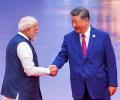
Ahead of Xi Jinping's visit, National Security Advisor Ajit Doval and Chinese Foreign Minister Wang Yi held extensive talks in Beijing on August 25 on the boundary issue and reached an eight-point consensus.

'India is trying to project that it can engage with the world in a different way too.'

The Finance Ministry has refuted allegations that US pressure influenced the decision to levy a 0.4 per cent Merchant Discount Rate (MDR) on select UPI payments. The ministry clarified that the NPCI guidelines prioritise RuPay credit cards on UPI to promote domestic alternatives and ensure a self-sustaining revenue model for smaller domestic companies, countering claims of favouring foreign payment providers.

Prime Minister Narendra Modi cautioned against the 'weaponisation' of technology and critical minerals at the BRICS summit, advocating for cooperation to foster shared prosperity. Concurrently, Chinese President Xi Jinping announced plans for an open-source AI ecosystem for BRICS nations, positioning Beijing as a key technology partner amid global AI competition.
The White House has released a framework for artificial intelligence, focusing on empowering parents to manage their children's digital environment and advocating for federal leadership to promote innovation and address policy challenges.

A high-level committee, including representatives from banks and payment associations, is set to decide on Merchant Discount Rate (MDR) for UPI transactions exceeding Rs 2,000 to merchants. While person-to-person and person-to-merchant transactions up to Rs 2,000 remain free, the move follows a recent amendment to the Payment and Settlement Systems Act, sparking debate and clarification from the Finance Minister that only certain high-value merchant transactions might incur charges.

The BJP's Jammu and Kashmir unit has strongly criticised Mirwaiz Umar Farooq for advocating the restoration of Article 370, asserting that the constitutional provision has been permanently abrogated and such calls aim to disrupt peace. The party emphasised that Kashmir has moved beyond past conflicts and is focused on development, while reiterating that statehood will be restored at an appropriate time, distinct from Article 370.
